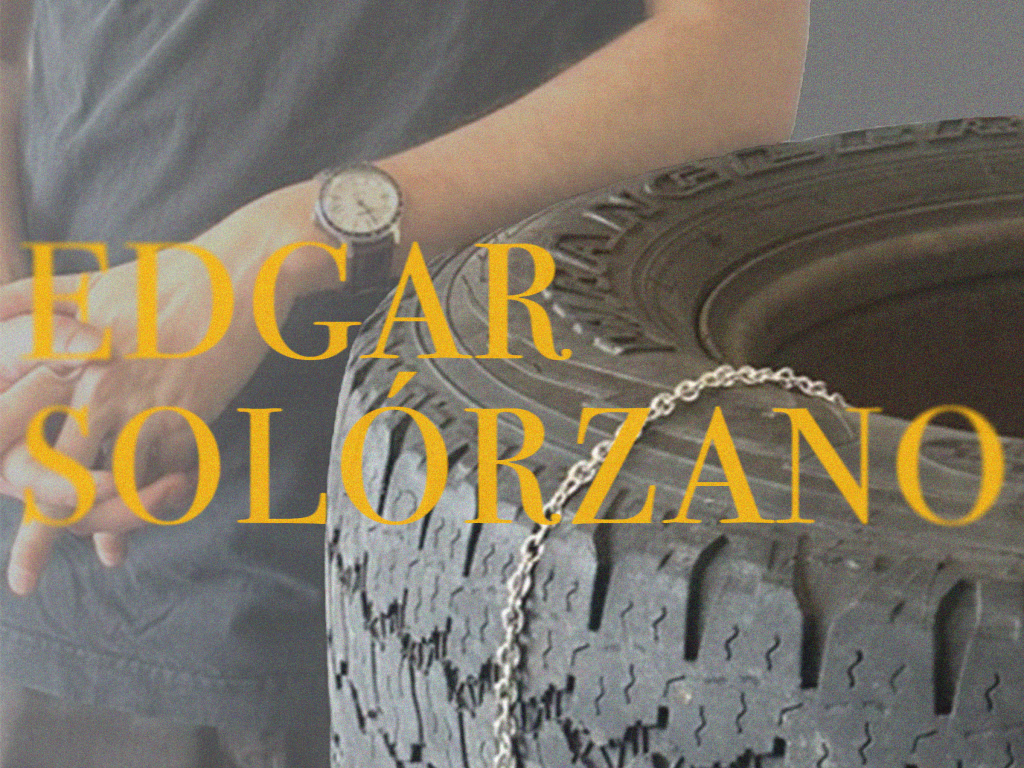
Edgar Solórzano grew up in Mexico City and fell in love with architecture’s promise while studying at the National Autonomous University of Mexico (UNAM) and the Bauhaus Universität Weimar (BUW). The theory of architectural practice, tied to emotional ideals of bodily, immediate, moving experiences, spoke powerfully to Solórzano. Post-grad, his trajectory followed a well-trodden path worn by many young architects. Working in studios, in interior design, even founding and ultimately shuttering his own firm. Through this period, Solórzano saw the aspirational soul of the work wither; poetry was replaced by excel sheets, budgeting, permitting, back-and-forth with clients.
Through this interval, which Solórzano describes as a time of “heartbreak,” he found himself recalling the architectural pedagogy celebrated in the Bauhaus. Rather than ending at building construction, the sphere of Bauhaus inquiry extended to the urban, historical, landscape-scale fabric that buildings live within. The school broke disciplinary boundaries as well: painting, poetry, and milti-media experimentation expanded the traditional technical foundation of architecture to one more suited to responding to the messy, cultural, social, and hyperpersonal reality of buildings. At 28, Solórzano made the decision to leave the relative stability of architecture and commit to a pathway as an artist.
His artistic practice, since that point, has pulled from the rich architectural case-study that is Mexico City. This work draws from and analyzes the existing urban fabric of this highly layered, complex city. Curtains caught in a breeze, desire paths in city squares, familial interior spaces blurred in memory. These seemingly mundane references are interrogated, analyzed, and transformed in Solórzano’s studio to question how broader political, economic, and colonial powers filter through to everyday life.
After roughly 7 years of working on exhibitions, museum intervention, fairs, and public projects in Mexico and globally, Solórzano committed to pursuing his MFA in Sculpture at the Rhode Island School of Design in 2024. It was around this time Solórzano became increasingly concerned with the influence of U.S. culture on his experience growing up in Mexico. Edgar’s studio floor is scattered with silk rose petals, scraps of upholstery fabric, plastic pearls, jewelry chain, and vintage hub caps. This smattering of mundane, largely synthetic objects reflects the artist’s broad interest in investigating the 50’s and 90’s, two periods of intense U.S. influence in Mexico. As he prepares for his thesis exhibition, which opens May 21, he invited me into this studio to discuss this direction of his practice.
The following conversation has been edited for flow, length, and clarity.

Charlie Usadi – I want to center our conversation on your recent work which has formed the foundation of your thesis. Your practice has always been interested in capturing urban, interior, and architectural memories of Mexico City, and it doesn’t shy away from linking these subjects to broader political contexts. Did this more recent interest in U.S. influence correspond to your move to the U.S., or had you already been working in this direction?
Edgar Solórzano – I definitely committed to shifting the scope of my work when I moved here, but I had already found myself thinking about the subject when I was still in Mexico. A defining moment for me occurred in preparation for my last solo show in Mexico City in 2024. A project involved the emotional reconstruction of my grand aunt’s house in the city, specifically the living room, where I would watch movies with my siblings growing up. In my head, it was classic Mexican movies we were watching, but I couldn’t recall which specifically we’d seen in that space. When I asked my siblings, my brother told me it was these American action films: Terminator 2, Independence Day. It didn’t make any sense at that moment, there was this feeling of discordance. In retrospect, I realize I was filtering my own memories, making them more “Mexican” when in reality, so much of what I consumed growing up was adopted from American pop culture: Hollywood, Metallica, Limp Bizkit… my school even taught me how to write in English prior to Spanish. So that started a process of reconsidering my upbringing, really picking apart where my childhood experiences came from. If these influences were born in a different country, a different culture, what did it mean to claim them myself? Were they really mine? It’s an experience I share with many in my generation. I realized that if my work was going to interrogate my upbringing, I couldn’t glamorize it as solely Mexican.
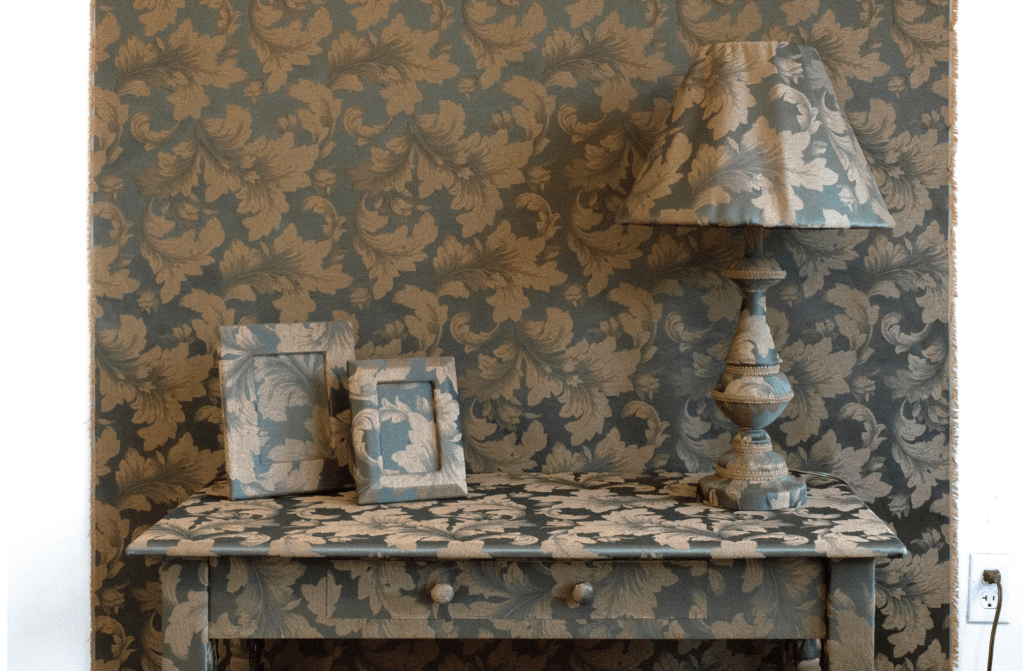
A domestic scene (metastasis), Upholstery fabric, reclaimed US American furniture, photo frames, lamp, 2024.
It sounds like it must have been a somewhat destabilizing moment, but clearly it was such a catalyst to prompt this more nuanced, “big picture” conversation concerning international influence, pressure, power. What strikes me is that while tackling these large-scale processes, your reference points remain highly personal, comparatively small-scale. Interiors, objects in memory, gardens, public space. There’s so much warmth in this work, even if it’s sifting through what sounds like a challenging reckoning with national identity.
So many of my projects are based on interior architecture, the skin of the house, the fabric of these spaces. I’m not as interested in designing spaces themselves as I am in remembering them, in understanding how these spaces from our past affect us so much. One of the best lessons architecture school left me was the concept that the language of architecture is scale. The ability to switch scales so quickly from, say, an urban blueprint to the detail of how furniture screws into a wall. I apply that to my projects, scaling geopolitical spheres down to the geopolitics of a cereal box. I enjoy that my work plays between “public space” to “private-public space” to “private-private space,” all of which are connected.
So prior to moving to the US, you’d already found yourself considering the American influence on your upbringing in Mexico. I’ve read your thesis, which chunks this influence into compelling categories: houses, cars, food, movies, language. Where did the work begin, and how did it expand?
It started with the architecture. My grandmother used to read American interior design magazines. She was never in the States, and she didn’t speak English, but I remember seeing these magazines and thinking “why are you reading this?” What was she trying to imitate, to participate in? There was something aspirational about it.
So I found myself wondering: “Am I remembering the house of my grandmother?” Is the house in my memory actually a representation of her, or is it filtered through these aesthetics which were implanted upon her? How much of my memory is similarly filtered through these American interiors I’m so familiar with through magazines, movies?
I’m interested in psychological and sociological research concerning memory, collective memory, how impressionable one’s memory can be. I realized that my work, to a large extent, isn’t about recreating “true” domestic architectures of my family, it’s about interrogating how those remembered spaces are formed to a large extent by outside forces. Architecture was the starting point, but from there the research quickly expanded to almost all aspects of my childhood associated with this house: movies, food, etc.
As you interrogate these memories, much of your work is grounded in periods of intense U.S. global influence.
Yeah, the post WWII era of American economic influence and the Cold War directly intersect with my parents upbringing and mine. My practice has been a process of turning over key images from my childhood and trying to understand why they were there in the first place. Why was I eating frosted flakes? Watching Terminator 2?
These tires, for example, I just got yesterday. I also have sourced two hubcaps, which are from the car model my dad owned when I was growing up. Lately, I’ve been interested in how masculinity defines itself in response to these foreign agendas and politics. Does it replicate them, imitate them, or is it subjected to and subordinate to this dominant patriarchal power. I found myself thinking of my dad’s car. To what extent was his car his? Did it represent his toy, his pet, a symbol of status, or was he preyed on by the influence of the American car industry? “Modern men” in the 50s were painted as these wielders of technology, machinery meant progress, and a pressure to participate is so prevalent in historical masculinities. So maybe this car served as a social tool benefitting my father, but there’s a part of me that feels like it had power over him at the same time.
The car has implications beyond just my family. In the post-war period, suburbanization was one element in a suite of “modernizing” ideals pursued by the Mexican government. Looking towards the U.S., the single-family home was romanticized and closely associated with success. Neoliberal policies began to benefit the development of a car-dominated urban landscape, which threatened the communal housing structures traditional in Mexico.
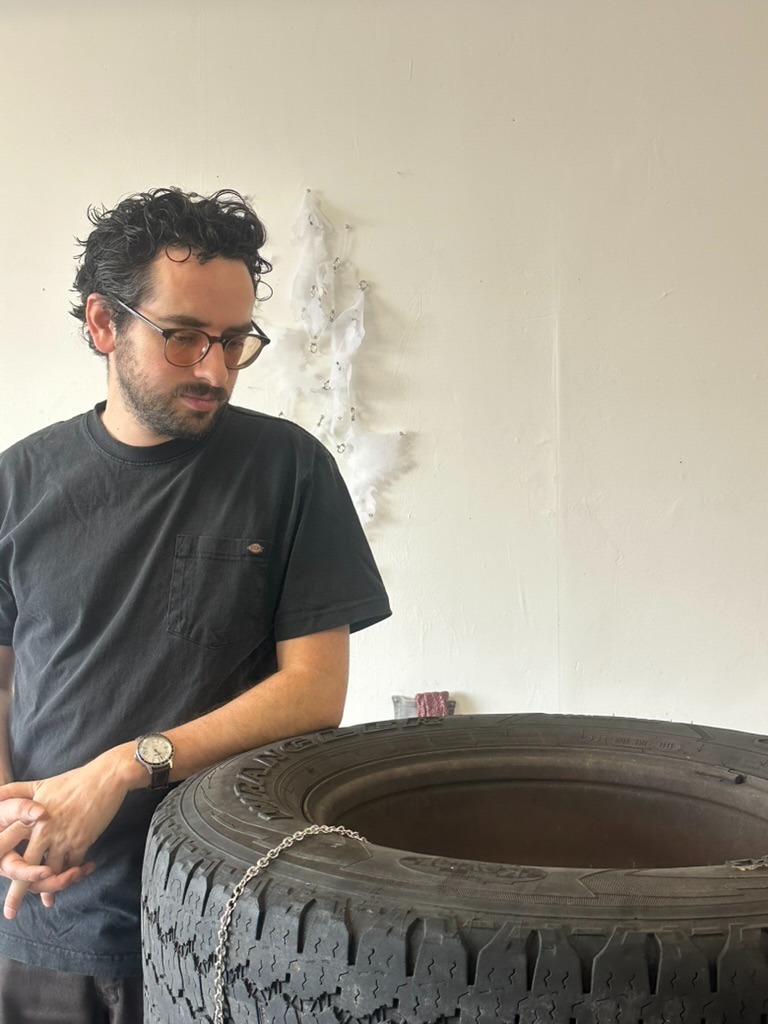
Edgar in the studio, with tires. April 24, 2026.
I think it’s because of this historical interest that you strike such an effective balance between hyper personal work and a more socially-minded artistic perspective. You work from personal reference points, but it’s so clear that these experiences are shared broadly. It’s, like, hyper specific to a whole community of people.
I’ve thought about that a lot. I can only talk about my personal experience, and my work is a process of excavating my personal and family history, but I hope it offers a methodology that can be useful for other individuals and their own personal context. It’s an idealistic way of seeing it, but I enjoy thinking of my work as a framework for how anyone can access large-scale histories, by filtering them through emotionally accessible reference points.
Your work beautifully evokes memory in the way that it’s gone through a process of material abstraction. You filter very mundane materials–furniture, found objects– through a surreal lens, and the work feels dream-like. I’d love to talk about how you put such disparate elements together, whether it’s synthetic rose petals, plastic pearls, found furniture. How do they respond to your conceptual research?
In my transition between doing really cerebral, “hard-line,” design in my previous career and the more emotional, “soft” interpretation of materials I’m pursuing today, I struggled a lot with that moment of translation from research to objects. For a long time I would complete a specific line of research, and make a decision, “this is the object which represents my research.” Instead of that one-to-one relationship of research-to-object, I’m increasingly aiming to be really open about when texts can inspire work. Whenever an element –regardless of how small– sparks my attention as I’m reading, I’m trying to follow that intuition, that bodily reaction to the text.
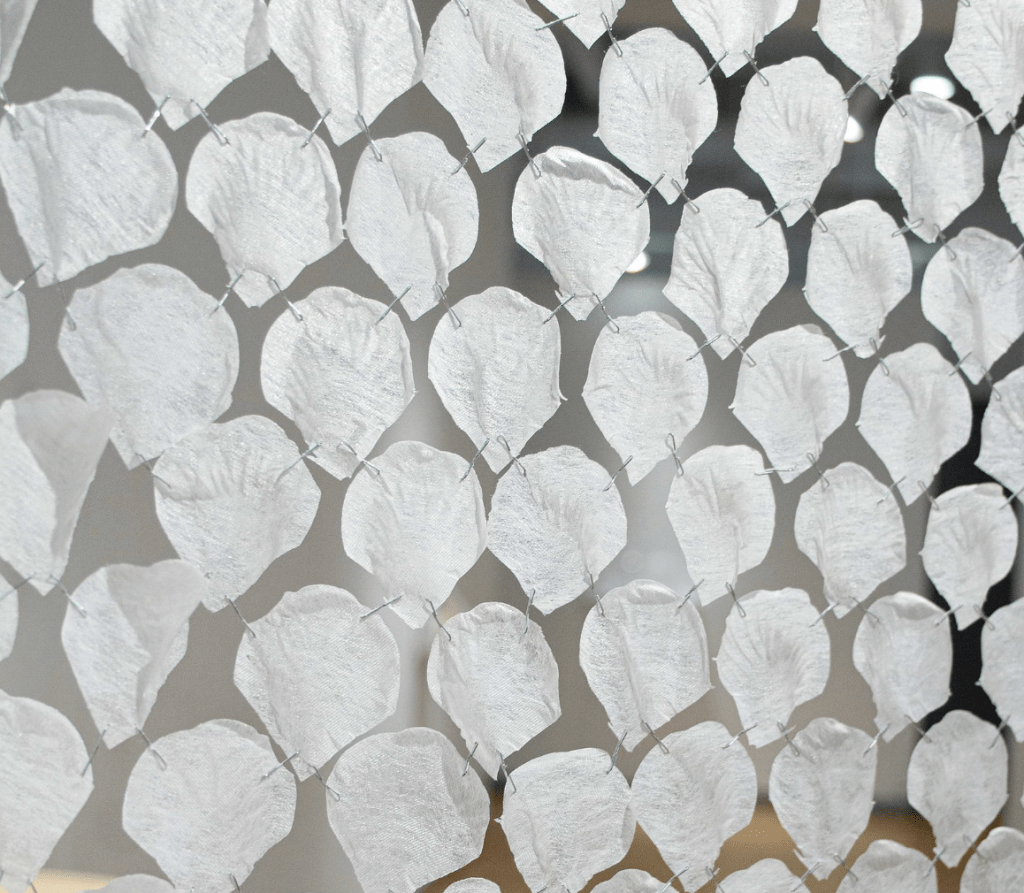
An embrace (for us) (detail), stapled fake flowers and galvanized steel. 2026.
In parallel, I’m letting myself make material decisions before I know where they’ll lead. Providence used to be a jewelry capital, so there are places where you can purchase pounds of old chains, pearls, and glass gems which would’ve been used for this industry. Where else could I find American-made fake pearls? It rings a bell which I initially didn’t understand, but which ultimately felt like a fitting response to my concern regarding my consumption of American aesthetics growing up. Being able to get to the “source,” to actually buy the real-fake-things. What does it mean to buy fake pearls, made in the US? I started buying these fake flower petals, pearls, and chains. There was something so horrible, but also fascinating about these synthetic-natural materials, even if I didn’t necessarily know how they might respond to my research. I’ve had them here for months in my studio, I’m living with these objects. After you see the same things over and over again, they start influencing your thinking, there emerges an intuitive crossing between the research and material.
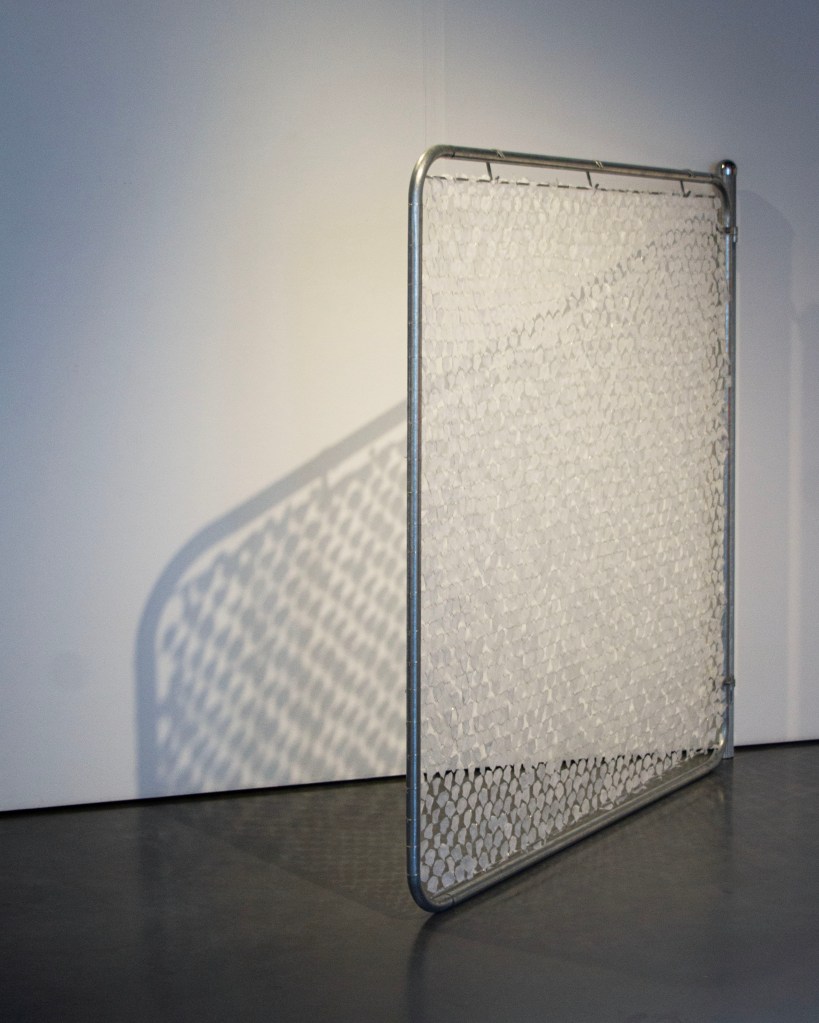
An embrace (for us), stapled fake flowers and galvanized steel. 2026.
I was immediately drawn to An embrace (for us). I love any work with fake flowers, I’m drawn to that disconcerting beauty of them which you described. Beyond these petals, your studio is currently filled with decorative floral fabric. I’d love to talk about these floral motifs which seem very central to your studio right now.
I think the obsession with flowers, or floral patterns, started in fall of 2024, when I just started the program. I visited Lorraine’s, this amazing fabric shop in Pawtucket. I was trying to source floral patterns from the 60s and 70s, to reconstruct this house I described. If my grandmother was consuming aesthetics from this country, I could do the same thing. There was a woman in the store with me, probably in her 80s. I asked her if she recognized any patterns from that era, and she picked this one. It felt like a full-circle moment, where I found myself consuming someone else’s memories, though it still remains this ubiquitous, mass-produced memory.
So I’ve been really obsessed with floral patterns and wallpaper. I painted these Chrysanthemums last fall, super grandma-core. These are painted with watercolor mixed with pesticide. Through my reading into the second World War, I became fascinated by Victory Gardens, this political push to mobilize all aspects of civilian life in support of the war effort. The pesticide I’ve used in these paintings is a modern version of the Pyrethrum-Based Insecticides recommended by the government to gardeners in the WWII era. Pyrethrines, the toxic component of this chemical, is actually synthesized from dried Chrysanthemums. These flowers are making weapons. Again, I’m trying not to make pointed conclusions, but I found myself thinking of families producing sons that are sent to war.
Domestic space fosters flowers, food, children, and, in this era, soldiers. Families send sons to war and flowers return, there’s this churning, complex machinery of people, nature, power. I learned that one of the biggest sites producing these pesticides during the war was in the Japanese internment camps. Chrysanthemums, in a lot of Asian cultures, are a mourning flower, while in the U.S. they represent victory, joy. So I painted with that pesticide.
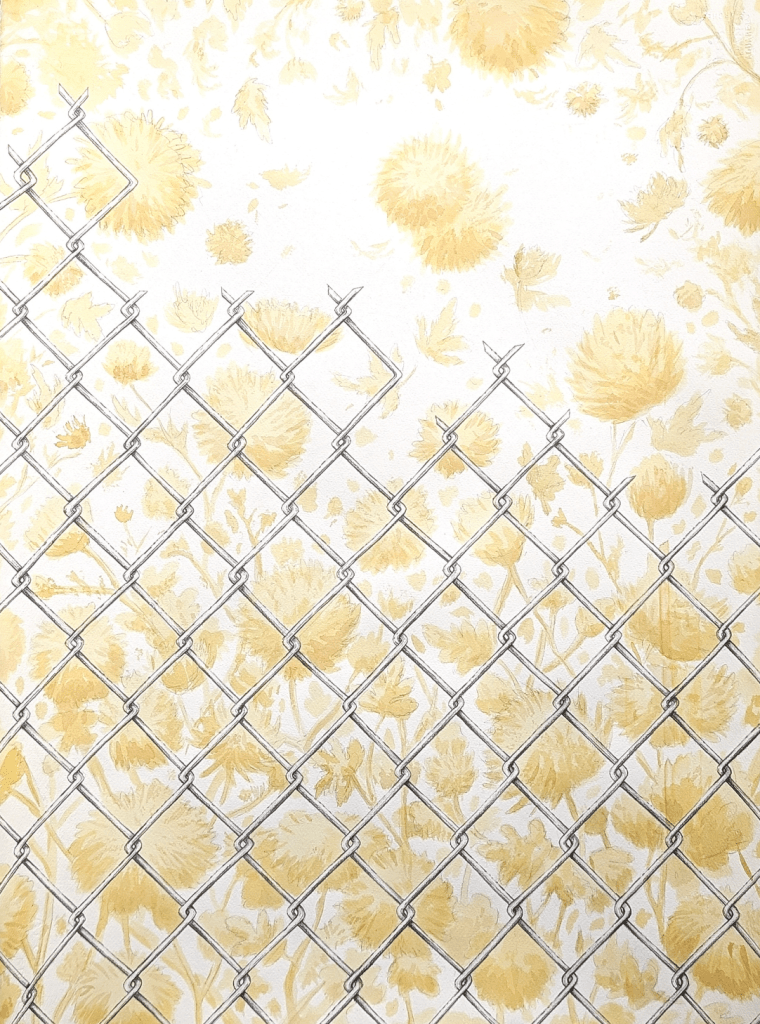
Victory garden 2, Pyrethrins pesticide, watercolor, and graphite on paper, 2025.
It’s a powerfully layered, nuanced symbol, and I feel like your integration of this chain-link patterning really establishes, for me, such an immediate association with a suburban setting, something only semi-natural. Something about the geometry in these paintings also recalls wallpaper, they feel modular in a way that could expand to cover architectural space.
Yeah, as I was conducting research into these decorative florals, I became fascinated by how wallpapers permeate a boundary between inside-outside. It feels like a corruption of the controlled garden.
It also speaks to a core throughline in your work, this idea that the exterior world so wholly pervades one’s personal and interior life.
Totally, in a semantic way of thinking, a fence, a curtain and a wallpaper all work the same way, all are both boundaries which encapsulate spaces, as well as porous filters, which let information through while changing its meaning. As I think about the U.S-Mexican relationship, something I’ve realized is that I will always have the Mexican perspective. One thing that I cannot ever experience is that US-American vantage point. But being in this country, I can work with the material culture of this country. Part of that process involved my decision to buy blinds that have been owned by a US-American family. How does it feel to see the exterior world from inside a US-merican household?
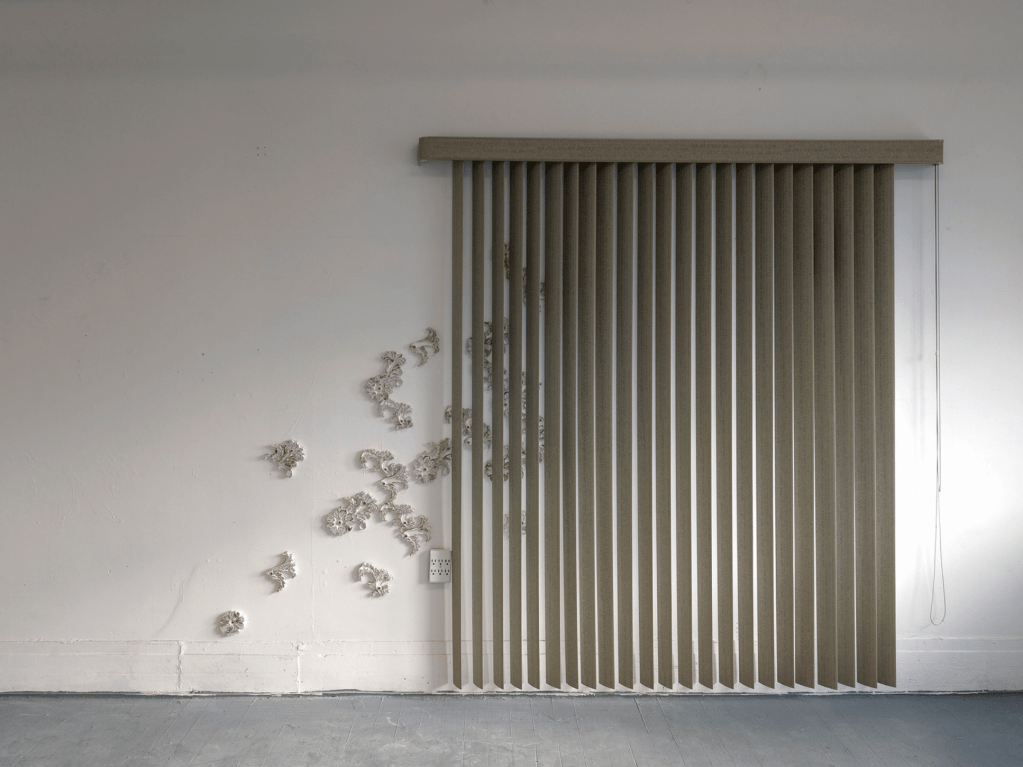
From afar, locusts and grass. Pre-owned blinds from an American home, pre-owned photo American frame, drywall flowers, speaker, 5:00 min audio loop. 2026.
It’s such a playful logic because it’s such a fallacy, right?
Yeah, totally [laughs]. I love pursuing half-made arguments, which work poetically rather than logically.
And while they’re absurd, you pursue them in a way which is so dedicated, so serious, that it respects those concerns core to the work. In terms of these dual perspectives, how do you think about exhibiting in the U.S. as opposed to in Mexico? How does the audience change the work?
That’s a great question, it was one of the biggest adjustments I had to respond to. In Mexico, I was used to having these shared references with my audience, so much of the work didn’t have to be said explicitly because it was understood. Coming to the U.S., I realized that I didn’t share as many common references as I thought. Similarly, I found there is a very broad diversity in how art is practiced and viewed, which presented a challenge that I’ve enjoyed. Something else I find really interesting in the U.S. is how important personal narrative is to artmaking. This is a generalization, but in Mexico City, most of the artists I know aren’t directly charging their work with highly personal information. Personal identity might be suggested or tangential, but there’s a lineage in Mexico, largely from the 90s, where artists respond to broad-scale concerns without that personal dimension. Coming to the U.S., my work was immediately met with questions of “who is this person? Where does this person come from?” The U.S. history of contemporary art is so tied to the individual. Abstract expressionist heroes are so emblematic of this preoccupation with the artist as opposed to the work the art itself is doing. This era is closely tied to my research. When you look into the geopolitical context of post-war America in the 40s and 50s, the cultural impulse is so clearly moulded by capitalist politics in opposition to socialist ideals of art for the people. It’s a lineage that exists in the U.S., whereas in Mexico you see a clear socialist influence.
Are there feelings you seek to facilitate in a viewer? Your work leaves so much space open to viewers. You act upon materials in such simple, poetic, evocative ways, creating works which aren’t so pointed, you don’t offer a thesis statement with this work.
Something I really enjoy is not finishing sentences fully through the work. That’s why I’ve been working a lot with installations lately, it means that no individual work has to say anything fully, they speak to each other and inform each other contextually. Each piece offers a fragment of a sentence, leaving space for viewers to finish them.
In terms of the response I seek in my work, at base-level I enjoy making pretty things. I like beautiful things, the aestheticization of topics, concepts, and subjects. I enjoy replicating the dynamics of propaganda, of offering something beautiful and hopeful, that tricks you into inviting it inside your home, into adopting it. But under the surface, underneath, I enjoy work which prompts these shifting moments of discomfort, after a viewer is drawn in. I like moments where someone’s already too invested to fully reject something. This lingering in between moments where something shifts, you spend more time with a work, and this grayish, murky feeling emerges. I want work to feel beautiful, but also harsh, sad, and funny. Offering viewers these murky, limbo experiences is a goal in much of my work.

Inaccessibility, from the “Pearl Flakes” cereal bowl series, crushed pearl, epoxy resin, alcohol ink, stainless steel spoons, ceramic bowl. 2025.
. . . .
Solórzano’s thesis work will be on view in RISD’s Grad Show, on view May 21 – May 30 in Providence’s Convention Center. Readers interested in learning more about his work can visit edgarsolorzano.com.
Interview conducted on April 24, 2026 by Charlie Usadi. Original photography by Edgar Solórzano, Sarah Meftah, and Charlie Usadi.


Leave a Reply