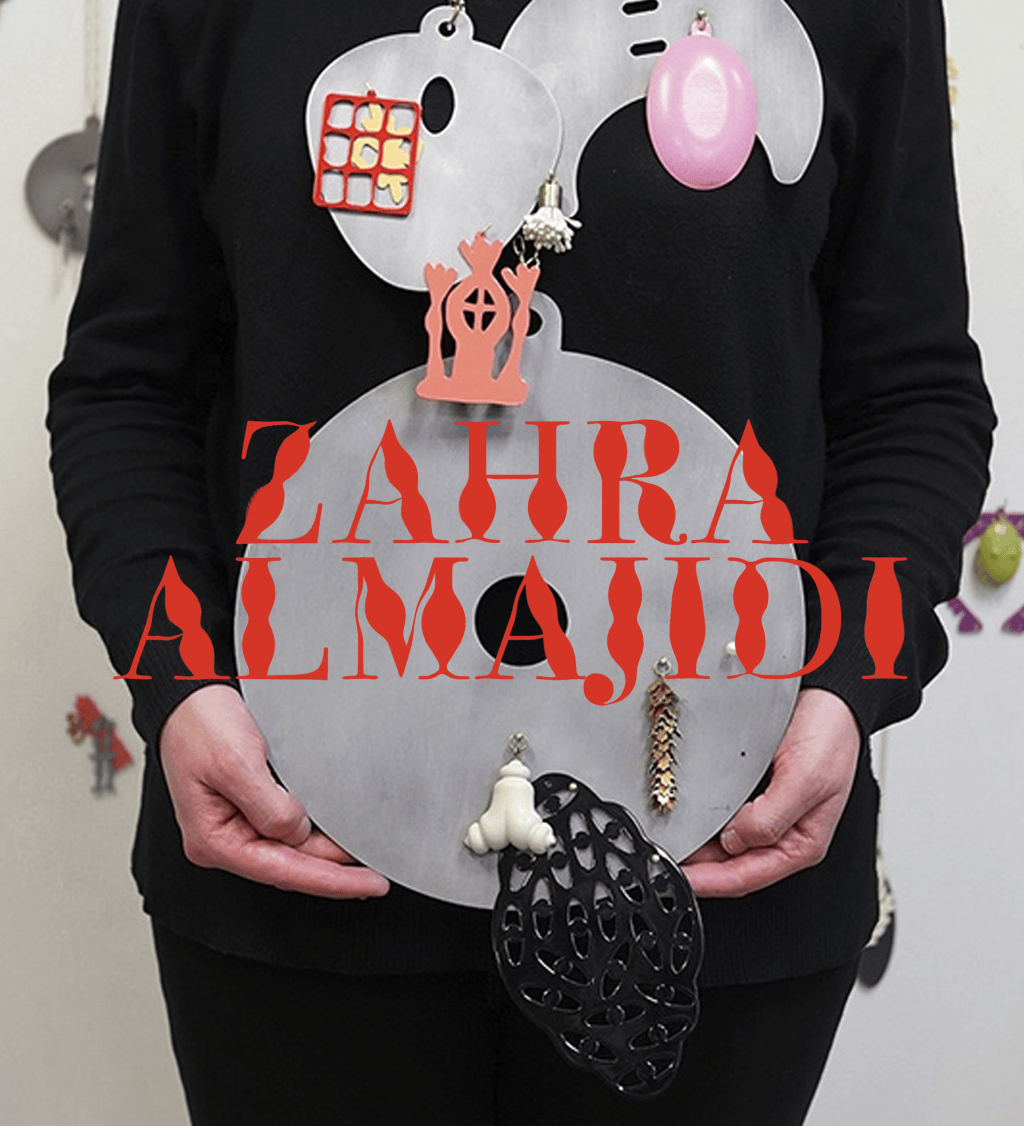
Zahra Almajidi is a visual artist, jeweler, and metalsmith raised and based in Detroit, MI. Almajidi’s jewelry and installation-based practice inundates spaces with symbols pulled from richly embroidered rugs from Iraq’s Southern Marshes. The symbols pulled from these objects capture the flora, fauna, people, and architecture of these marshes, a landscape drained as part of the forced displacement of Marsh Arabs in the 1990s. Synthesizing traditional and digital metalsmithing processes, Almajidi’s practice imagines futures not only for Marsh Arab cultural practices, but for the landscape which produced them.
I was lucky to meet Zahra last year at the Haystack School of Craft in Maine, and was grateful for the opportunity to discuss her practice in late September this year.
The following conversation has been edited for length, flow, and clarity.

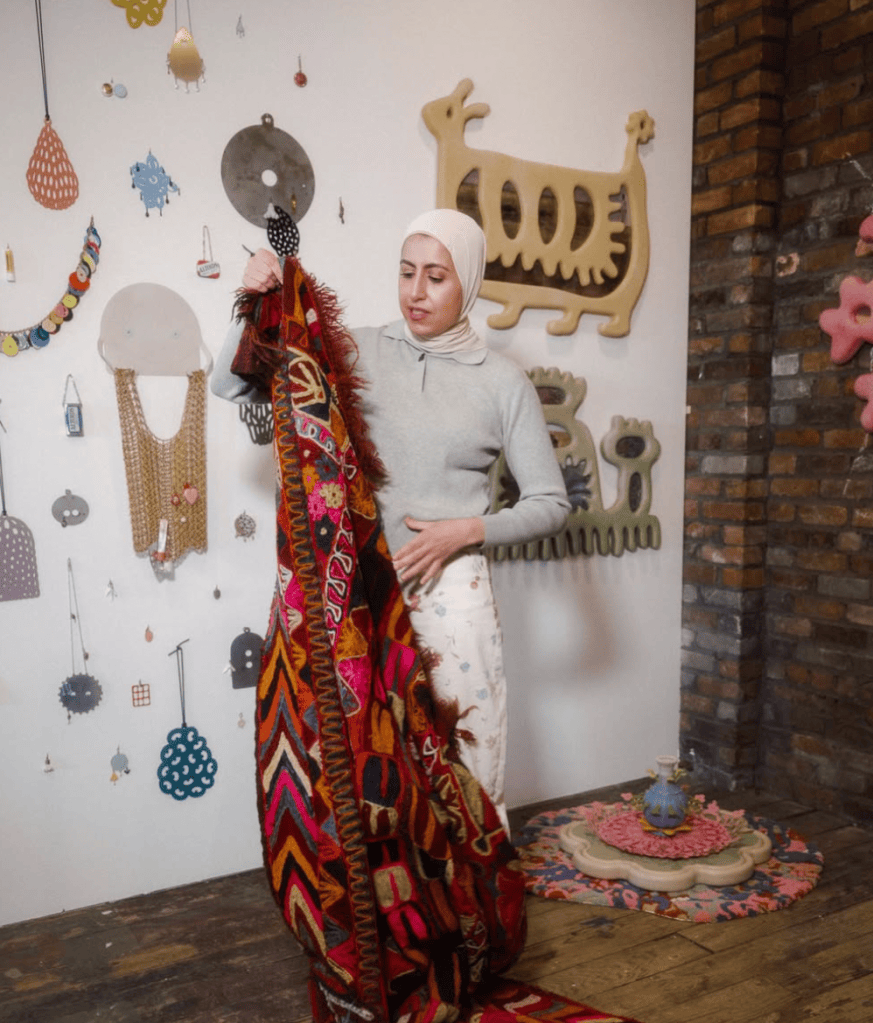
Almajidi in the gallery at Play Detroit, 2026.
Photo credit: Brian Romero.
Charlie Usadi: Hello Zahra! You’ve been quite busy recently, so I was thinking we begin by discussing your most recent exhibition, your recent work, then we can more broadly discuss your practice and how you’ve gotten to this point?
Zahra Almajidi: That sounds perfect. My exhibition currently on view is part of a fellowship with Playground Detroit. These fellowships are offered as an opportunity for emerging Detroit artists to get their foot in the door working with commercial galleries–it’s actually the first commercial gallery I’ve ever worked with.
CU: Congratulations!
ZA: It’s been really great. It’s gotten me to think about my work in ways I’ve never had to before – Inventorying, documenting, pricing, leading workshops – it’s been a real learning experience.
In regards to the show itself, Casting the Net was exhibited as part of “Detroit Month of Design”. Detroit is one of the only UNESCO designated cities of design in the US, and the entire area is activated for the entirety of September with exhibitions, workshops, and events. In previous exhibitions, particularly my show When the Water Dries Up at the Sculpture Center of Cleveland, I’ve looked back at a very particular region of Iraq called the Southern Marshes. In Saddam Hussein’s attempt to ethnically cleanse this community, marshes that had existed on record since ancient Sumeria were drained. In a matter of a few years these marshes that had lived for thousands of years were decimated. When the Water Dries Up specifically considered the ecocide that occurred in the region, a process in which a previous way of life is made to be impossible, where life can’t be sustained and a community can’t return to the land. When the Water Dries Up focused not only on the environmental devastation but also on the people and the craft tradition in this region. The weaving, metalworking, and embroidery of this culture in many ways ceased to exist, and the exhibition considered what remained when the people left.
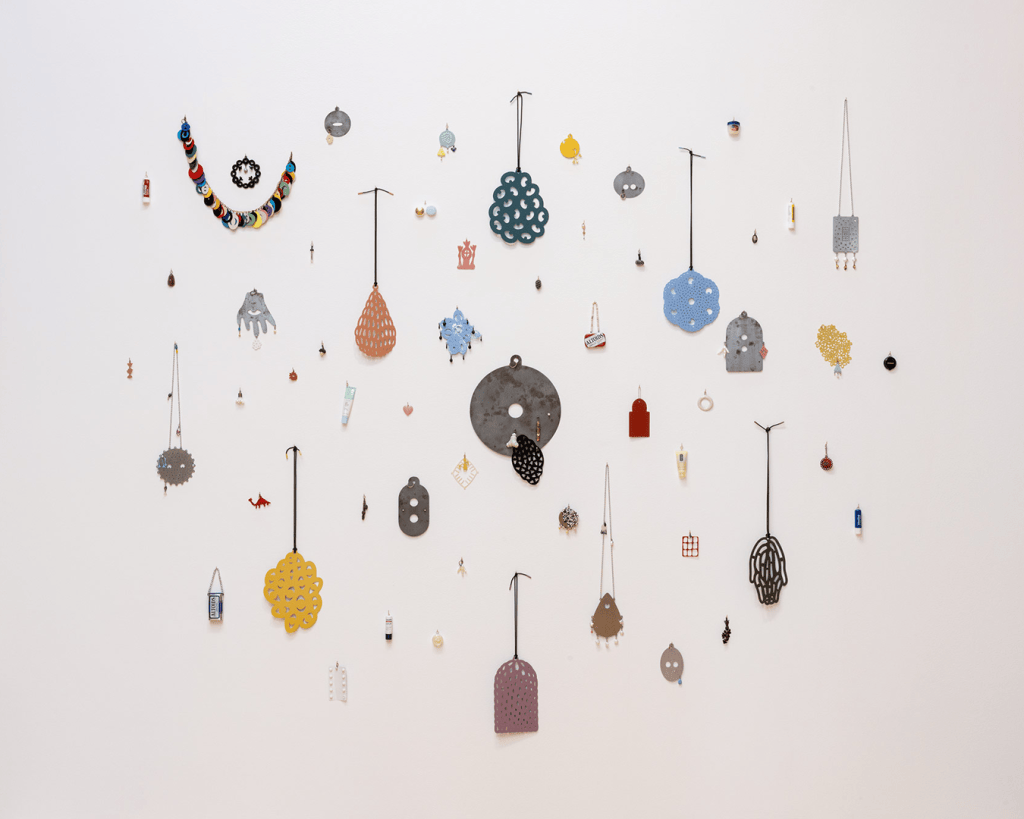
When the Water Dries Up installation view.
The Sculpture Center, Cleveland, 2025.
Photo credit: Jacob Koestler.
So that early exhibition in many ways was backward-looking, whereas Casting the Net offers a forward-looking perspective. More recently, there have been efforts to revitalize the marshes, to bring water and people back to the region, and every now and then the region sees heavy periods of rain in which these wetlands fill back up temporarily. There are these beautiful videos of water buffalo returning to roam the water in these periods of flood, which I’ve pulled from news reports from Reuters, Al-Jazeera, and a few other outlets. In past shows, much of my imagery was pulled from archival documentation of the marshes in their most decimated state, so this transition to images of life is a major change. That being said, climate change is still very much a consideration today, so I’m interested in the implications of revitalization. The previous exhibition was a speculative past, and this one is a sort of speculative future.
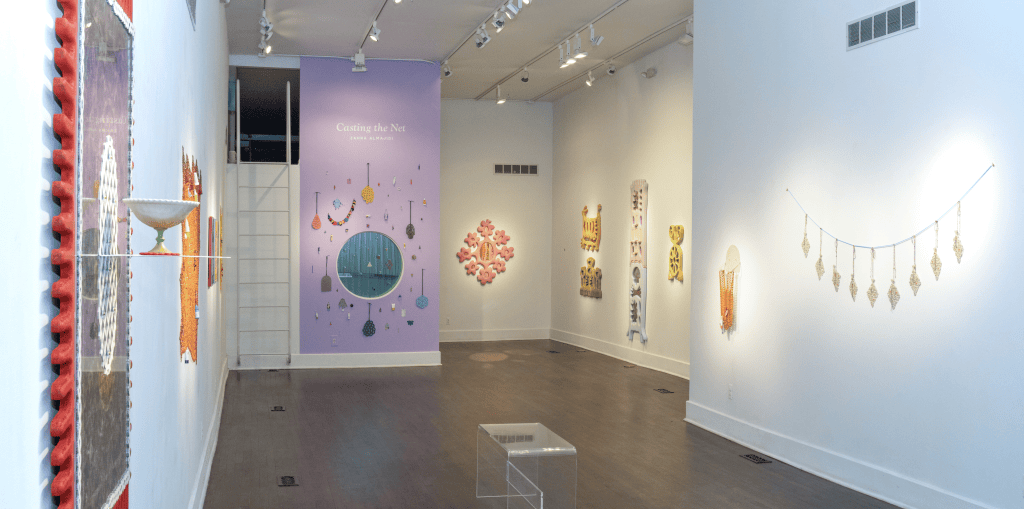
Casting the Net installation view.
Play Detroit, 2026. Photo credit: Maha Hmayed.
CU: Is there a tension between imagining the future of the landscape while also acknowledging the reality of historical devastation?
ZA: Yeah, there’s a tendency for those in the diaspora to really romanticize what the land was and can be, and a deep nostalgia is prevalent where you sometimes see a denial of those harsher realities. These marshes will never be what they once were, but they can become something new. The symbol of the net, for example, is very significant in the current exhibition because fishing was central to the culture; the draining of the marshes denied these communities their ability to subsist in this way. The net is a receiver, but it’s also a giver of life. I’ve been crafting these nets out of chain which emerge throughout Casting the Net. One of the most exciting pieces I’ve created was this string of fish – not living fish, rather, fish skeletons. So, instead of trying to rewrite this landscape, the work is a process of acceptance. I try to look at the state of the marshes as they are, contending with the reality of a landscape rather than idealizing it.
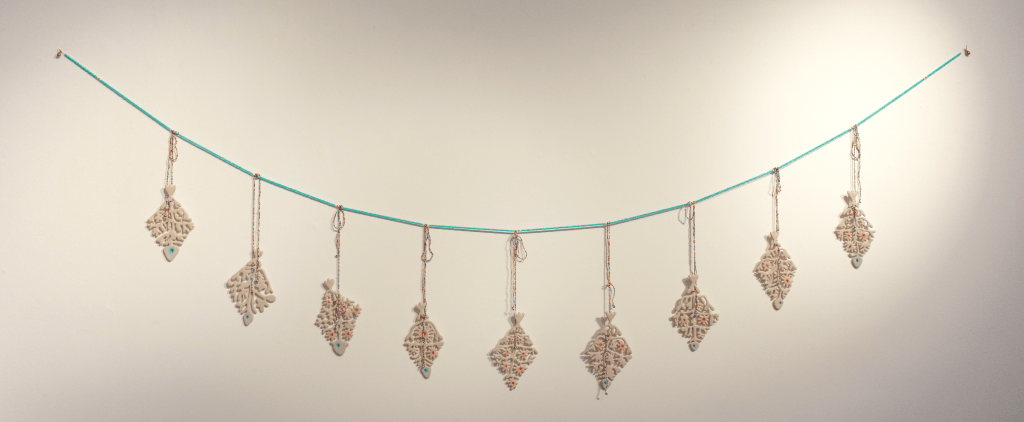
Preserving, 2026.
Nylon rope, nylon plastic, glass beads, brass.
Photo credit: Maha Hmayed
CU: Your work is immediately informed by the archive, by historical context, by traditional craft. How do you honor this history while imagining new futures?
ZA: I’ll always acknowledge the past, but I don’t want to be stuck in it. I don’t want the people, or the culture of craft I’m considering, to be frozen in time. Despite this tragic history there’s so much possibility, so my practice at its core is a forward-looking one. I’ve been exploring the imagery of traditional rugs made in this region for a long time, but I have no intention to recreate them. I’m very clear that my work isn’t a process of going back, it’s a response to this history, and jewelry is my way to do so. Jewelry has always been where I’m most comfortable, I got my MFA and BFA in metalsmithing, so when considering what I can contribute to these cultural craft traditions, jewelry is the best way I know how to do so. Jewelry is such an intimate craft, it’s held so close to the body, something I can hold close to myself, so it’s the most loving way in which I can make this work. Even when the work I’m creating extends beyond jewelry or charms, when I’m making frames or furniture-scale objects, I see them as accompanying the jewelry, existing in the same universe.
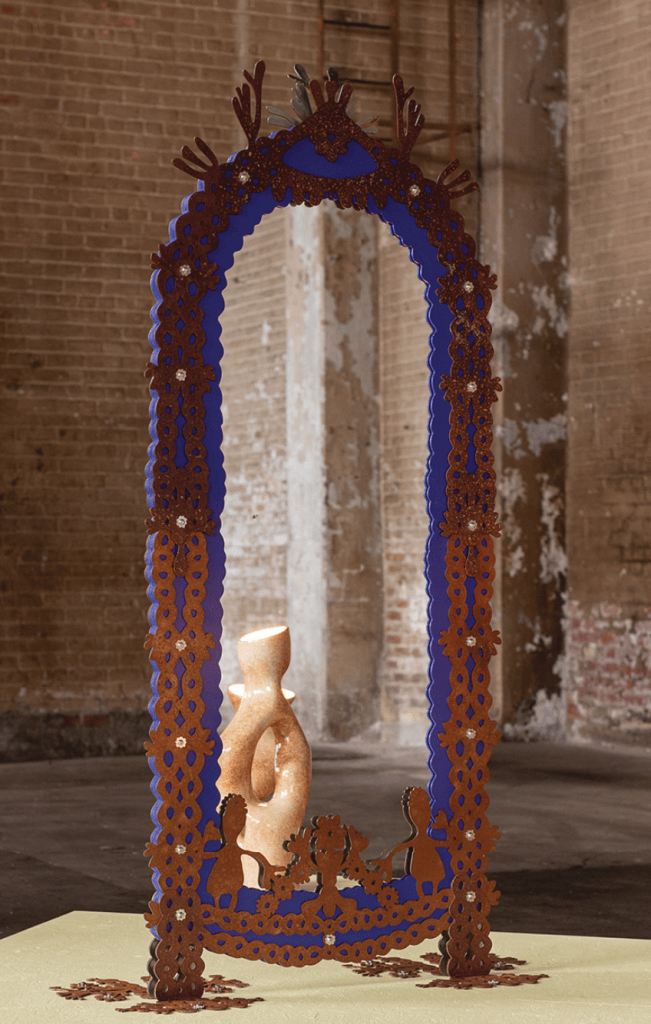
Mirrored Histories, 2022.
Mild steel, MDF, mirror glass, stainless steel hardware.
Image credit: Clare Gatto.
CU: Something else that unifies these works is that they all speak to interior space. Considering that you’re pulling primarily from carpets, it makes sense to me that much of your sculpture takes the form of domestic objects.
ZA: Growing up, my parents would often reference this very specific region of Iraq, so I finally began researching this culture and quickly discovered these wedding rugs which are unique to the Marsh Arabs. Through my research, I was able to find the writings of historic anthropologists who’d spent time in the marshes who recorded the history of these objects. From my understanding, these rugs didn’t hold deep symbolism but they were highly representational and iconographic. They richly depict the flora, fauna, and architecture of the region. The base of the rugs would’ve been woven on a floor loom, and the surface imagery was embroidered with a consistent chain stitch across the surface. Early rugs had neutral colors, but these craftspeople took advantage of the introduction of synthetic dyes in the mid-20th-century, at which point the symbols in these rugs emerged in vibrant turquoise, pinks, neon yellows. You’ll find donkeys, camels, fish, mosques, women, men, reed houses. These rugs capture the imagery surrounding these craftspeople, and the environment was integral to their work. It’s always been a dream of mine to completely transform an interior–from the walls to the floors to the ceiling to the objects that adorn those surfaces. I like to think that I’m making things that exist in a universe; at this point I’ve made photo frames, mirrors, tabletops, vessels, rugs, jewelry. I’m slowly working towards a point where I could fully transform a space. My next two goals are clocks and lamps.
CU: Even in the larger objects you’re creating, I find that the language of jewelry seems to inform all of your work. When did you first find yourself scaling up?
ZA: I really appreciate you noticing that I approach all of my work with a jeweler’s mentality. It’s the way I approach adornment, ornamentation, and the decoration of space as I scale up. I do scale up and down often. I started scaling up shortly after graduating from graduate school at Cranbrook Academy of Art, in 2021. I was very fortunate to have a series of residencies in the few months after graduating, first at Talking Dolls Detroit and then at the Arab American National Museum. I was given the space and financial resources to be able to scale up. When you’re a student there’s a tendency to focus in, but graduating offers a freedom to explore, so I felt like I could really explore, and the work got bigger and bigger.
CU: In terms of the spaces you’re filling, you so deeply inundate these spaces with symbols of the Southern Marsh culture. It makes me consider the site and belonging in regards to your work. Do you imagine these objects living in Iraq? Or are they diasporic works which belong in North America?
ZA: That’s a good question, I’d mentioned that my work offers a speculative future, but it’s also a speculative present. It’s a representation of my current lived experience in the sense that I’m far removed from the region. I recognize my positionality, that my understanding of this cultural craft is positional, and that I’m working in conversation with a region distant both geographically and temporally. I make these works from the perspective of someone who has been displaced. It wouldn’t make sense to take these objects “home” to Iraq, because the US is very much home to me and it’s where these objects are born.
CU: There’s something to be said for these objects, which can only exist because of the process of relocation, of assimilation. They might be connected to the Southern Marshes but they can only exist because of your lived experience in the United States. Something you’ve described before is digital mediation between you and the symbols and images you’re working with. What does that digital interfacing mean to you?
ZA: Yeah, the objects I create are about a place but they’re not necessarily from a place. They’re diasporic, hybrid objects made by a diasporic, hybrid person. Does it make sense to bring them to a place which they honor but never really knew? Everything in the work comes from the objects, from the symbols, that I live with. The work emerges from those references immediately occupying my thoughts, both physical objects I’m surrounded by and images I encounter daily.
For example, my introduction to rugs from the Southern Marshes, in addition to my more recent exploration of other craft objects from the region, has been almost entirely through the digital realm. As I began researching these objects I quickly became obsessed, but I could only access them through a screen. I’ve found these rugs on auction sites, online blogs, Google image searches, often only accessing low-quality images. Early on I began hand tracing every clearly defined shape I could find in these images I collected. I’d trace their outlines by hand, ink them into solid forms, and scan them back in to digitalize them in Illustrator before cutting them in metal to create physical charms. Originally, these forms were purely one-to-one direct copies of the original shapes, but as my work scaled up these forms began to evolve into amalgamated, hybrid, almost confused shapes and patterns which repeat in my frames, mirrors, and vessels.
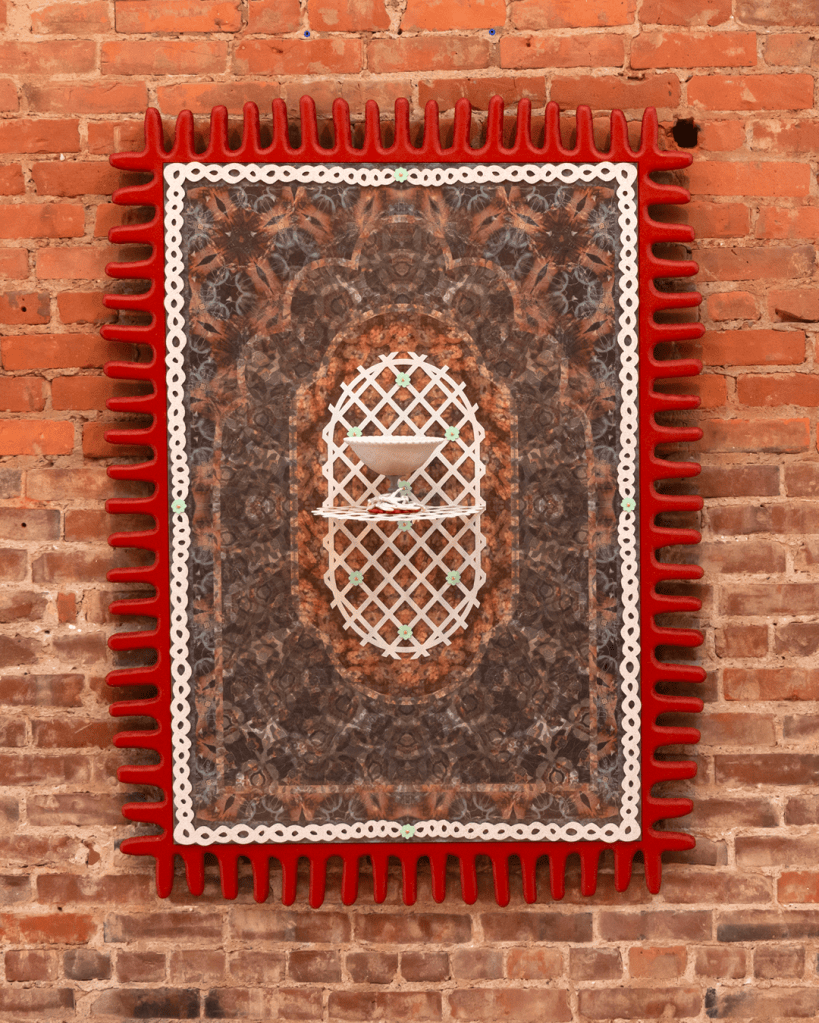
Holding On, 2025.
MDF, inkjet print, acrylic, stainless steel,
brass, 3D printed plastic vessel, pearl.
Image credit: Brian Kovach.
CU: Your description of tracing these blurred images is so fascinating, this idea that there’s a film or a filter, a disconnect, between you and these craft objects. On one hand someone might consider it a loss, you can’t recreate these symbols perfectly, but you’re able to turn what might be a loss into a strength by taking advantage of the repetition, mirroring, and iteration central to digital fabrication. It also rings true to the reality of your digital engagement with these rugs.
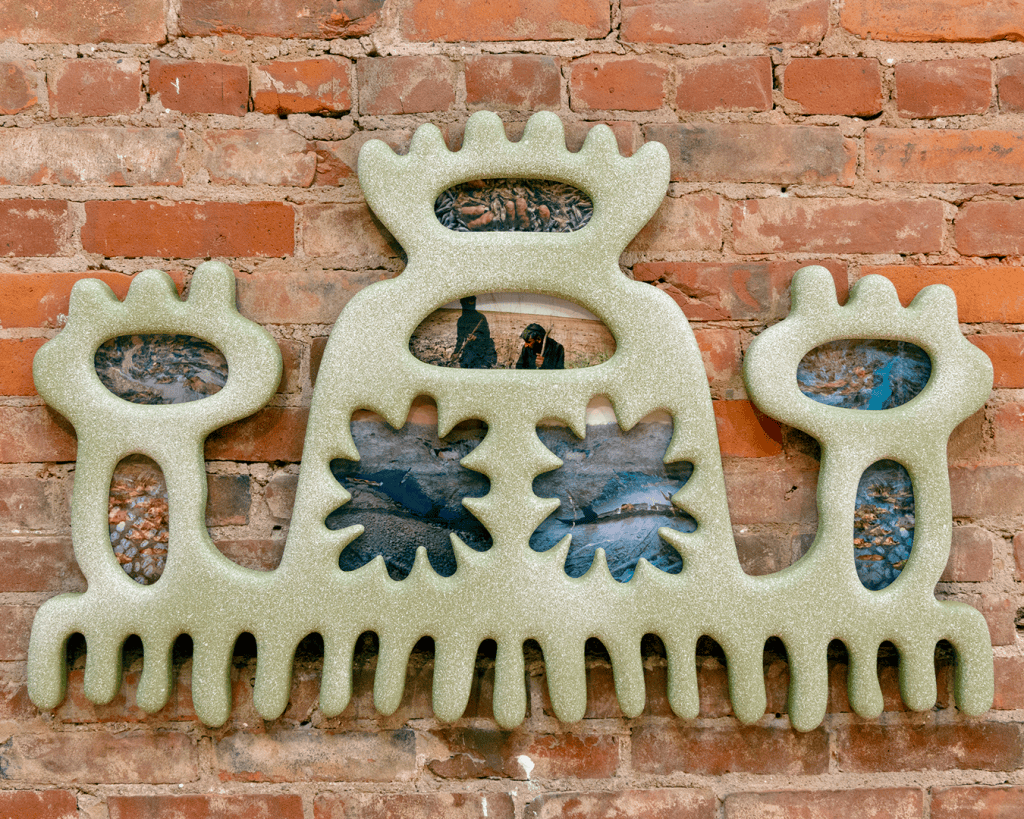
Going Back/Moving On, 2025.
MDF, inkjet prints, acrylic.
Image credit: Brian Kovach.
ZA: That idea of the filter is so significant because as I’m tracing even a single pixel influences the resulting images, it’s something I embrace. This filtering is a huge part of my process, particularly working through imagery. Every image of the marshes I encounter is filtered through secondary sources, tertiary accounts, secondhand accounts. I apply my own filters to acknowledge that what I work with aren’t pure, primary sources. In many ways I’ve only been able to encounter these rugs digitally, so there’s a truth to transforming them using digital processes.
CU: It must be freeing, in a sense, to so transparently acknowledge that blurring. So much of this cultural history must be lost, so how could anyone claim to capture a true picture of what it must have looked like. Even given your family history, it would be too much for anyone to expect you to offer an unclouded understanding – you work with what you have access to.
ZA: I’m not presenting myself as an anthropologist or a historian in any way. I’m a craftsperson approaching this history from my own perspective. I make a concerted effort to situate my work as an individual interpretation crafted from the sources I encounter. When describing my work I make a point to say “From my research I have found…” The work represents my individual understanding of the resources available, it opens up the space for speculation and mythmaking in my work.
CU: Are any rugs made in the region today?
ZA: Not as abundantly as they were. Historically the region was isolated from much of Iraq more broadly, and these objects were made out of necessity. These rugs were lived with, used, so I imagine there was a real pride in their craft and design. After being displaced, these people suddenly had access to other rugs and blankets, so the making of these rugs wasn’t as necessary. I imagine it would be really hard to maintain craft practice in the midst of displacement when survival takes priority. Unfortunately, the displacement of the people erodes the knowledge necessary to create these objects. The loss of elders puts cultural knowledge at risk. From my understanding the rugs stopped being regularly made around the 80’s or 90’s, though there have been efforts to bring the craft back. I’ve read that there are efforts to expand the tradition to broader Iraq. That being said, the environment was so integral to the imagery in these historic rugs, so it would make sense that the changing of the environment would also change elements in any rugs created today.
CU: And to return to this concept of nostalgia and change, even if this tradition is revived, what comes back is something foundationally different. The land is different, the people have gone through a profound transition and interacted with different groups, you’d described how the material culture was already transforming after the introduction of dyes. Craft is so intimately tied to context, and the work you create, so transparently hybrid, feels like an extension of a history marked by change, displacement, and resilience.
. . . .
Casting the Net closed at Playground Detroit on October 3, 2026. For those interested in learning more about this exhibition and Zahra’s broader practice, I encourage you to follow her work on instagram.
Interview conducted on September 30, 2026 by Charlie Usadi. Cover image credit goes to Bonnie Xue, and banner images are courtesy of the artist.


Leave a Reply