Until July 9, on 49 Westfield Street, Providence, eight Rhode Island-based artists have activated a historic mill in the exhibition, “Tracing Time”. The show, curated by Sara Ahli, spans glass, ceramics, woodwork, new media, and photography, an assemblage of works which resonate both hyper-locally and across broad geographies. Brought together, this interdisciplinary presentation creates space to meditate on site, belonging, memory, and identity in built environments characterized by legacies of constant churn.

“Tracing Time” belongs in a city like Providence so immediately molded by change. In myriad ways, the city owes its eccentricities, somewhat confounding layout, and architectural character to the complex cycles of development and redevelopment which have crafted it. A walk through Providence points towards histories of industrial transformation, economic boom and bust, urban renewal, inconsistent municipal investment, in addition to the more recent patterns of environmental rehabilitation, architectural reuse, redevelopment, and grassroots organizing.

Alex Wenstrup, Providence Pano. inkjet, glass, wood.
“Tracing Time’s” more specific site context, situated in the city’s West End just off of Elmwood, similarly fits the conceptual work pursued by the artists involved. When you arrive on site you’re met with the historic Stedman and Fuller Manufacturing Company Complex, a sprawling assemblage of brick structures punctuated with the large gridded windows, arched lintels, and restrained ornamentation characteristic of New England industrial architecture [An abridged history of this historic site can be found at the bottom of this text]. Today, like many other former industrial buildings, Stedman and Fuller has been transformed. The complex now boasts 40 designer residences which promise high ceilings, hardwood floors, central air, and “oversized windows.” The complex also offers workspaces, offices, and a cafe recently opened in one of the building annexes. It’s in one of this (re)development’s currently vacant retail units that Sara Ahli was able to stage “Tracing Time”. Interior details in this gallery-not-gallery hint towards the site’s industrial history: crossbeams of cracked concrete and patinated steel criss-cross the ceilings; brickwork on interior walls reveals windows sealed during redevelopments, and the unintuitive floor plan, punctuated by brick pillars and side rooms, offers the idiosyncrasies expected from a site previously activated and reactivated in succession. It’s in this context that “Tracing Time” does its work.

Alex Wenstrup, From Fatty (White) [left] and From Fatty (Black) [right]. Glass, ash. (Image credit: Travis Lemire)
Architectural landscapes are interrogated at myriad scales across the exhibition: Alex Wenstrup takes a step back, segmenting a Providence skyline across panes of glass in his saw-toothed Providence Pano. In the same space, Wenstrup’s work focuses in on the building-level in his cast glass echoes of highly geometric, architectural motifs (Alhambra S, From Fatty (White), and From Fatty (Black)). Clara Delgado’s photographs — Ledge (No.2), Threshold, and Foyer — step inside, pulling viewers into quiet, interstitial moments of New England interiors.

Clara Delgado, Threshold [left] and Ledge (No.2) [right]. Archival Inkjet Prints.
Deeper than surface-level physicality, “Tracing Time” also interrogates architecture’s porosity, personalities, capturing the transient, slippery, emotional qualities layered into built environments. Will Beattie takes viewers to the circus in his multimedia Panoramic. Beattie captures the performative, alluring role architecture plays in these contexts. A small-scale, glass-cast ferris wheel, illuminated from behind by polychrome LEDs, entices viewers into close proximity with its intimate spectacle. The light box housing Beattie’s mirage, with its concave facade, recalls the cinematic, performing architecture of 19th-century cycloramas. Architecture’s power to lure us in is on full display. Matthew Napoli’s paintings evoke relationships nurtured in residential interiors. A bubble-level, teetering between limbs in Napoli’s Balancing, recalls the collaboration critical to furnishing a new residence, while Power Strip’s central mass of extension cords, charged with energy, speaks to makeshift collaboration which emerges between cohabitants.

Will Beattie, Panoramic [left] with detail [right]. Cast glass, arduino, LED, acrylic. (Detail credit: Travis Lemire)
“Tracing Time” does more than celebrate architecture’s allure, it cautions us to consider it critically. In Nathan Wright’s carefully arranged A judgement in stone, the processes of urban planning, map-making, zoning, site survey, and construction play out at insect-scale. Graphite lines carefully grid out wooden blocks, minute ceramic forms, and found objects carefully placed across the work’s surface. At once, A judgement in stone evokes a natural history collection, site plan, and a classroom floor strewn with wooden blocks. Two-channel video, positioned at either end of this assemblage present looping video: to the left, aging wood teems with a mass of termites; at the right an excavator rumbles across a job site, raising a plume of dust.

Nathan Wright, A judgement in stone. Multi-channel video, glass, wood. (Image credit: Travis Lemire)
Wright places the viewer in an uncomfortable position of power, gazing down upon an imagined landscape in miniature, with all of the game pieces laid out, we’re invited to play the game of city planner. Presented in Providence, a city with a well documented history of late-20th century redlining, “urban renewal,” and demolition, the sobering title of A judgement in stone reminds us of the reverberating impacts of decision-makers, scars in cities. Resisting common associations between built environments and enduring monumentality, this work displays fleeting, ephemeral architectural moments charged with emotion. Skylines, apartments, neighborhoods, and the relationships formed within them are fleeting, prone to disruption. Architecture may be a circus, but the circus packs up and leaves.

Malda Smadi, Zeitoun. Clay, suede, rope, olive oil (Image credit: Travis Lemire).
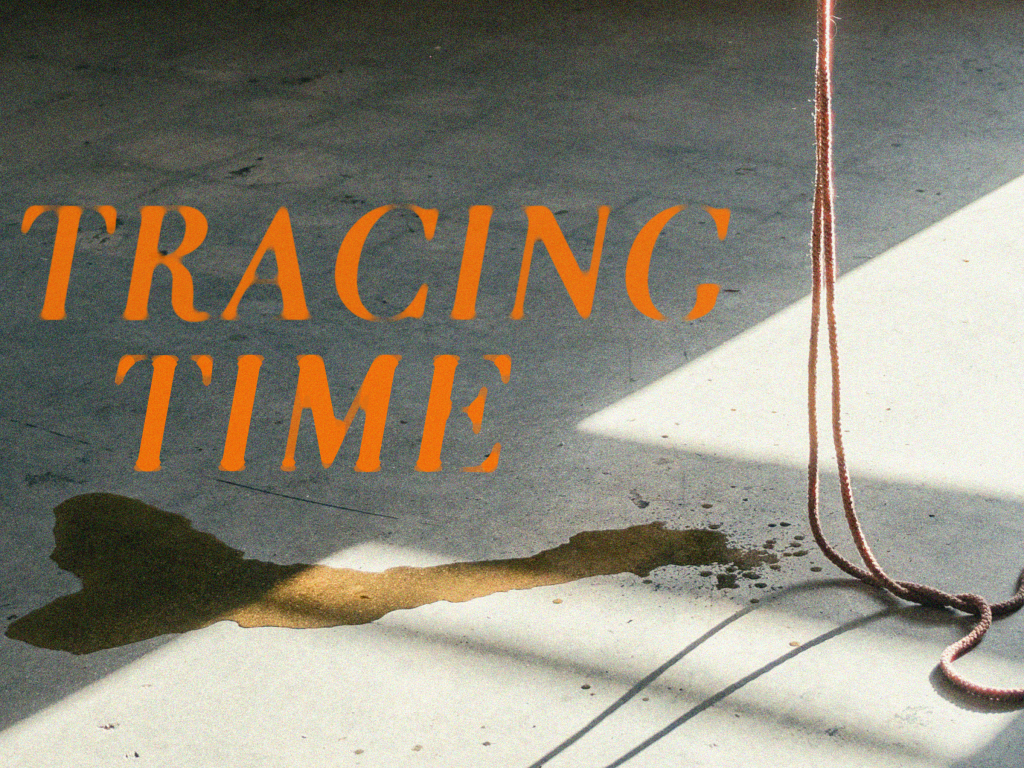
The exhibition, at its core, speaks to context-critical themes at play in Providence, but its strongest moments might its works in which global narratives resonate with domestic urban concerns. Malda Smadi’s Zeitoun hangs in the center of the entry gallery, dangling from a concrete beam. The work’s hand-formed body is clay, sheathed in scraps of suede which delicately texture its surface. The form is at once cradled and bound by the thick rope suspending it. At the exhibition opening, olive oil spilled from a hole at the bottom of its hollow body. The name of this work is drawn from the arabic, زيتون, “olive,” tying the piece intimately to the middle east, a context currently marked by upheaval, forced migration, extirpation. The ceramic pit – some might call it a “stone” – speaks to what remains, what persists, what’s left to be found once the flesh is stripped away. There’s a precious, precarious nature to this work. Zeitun cradles an artifact left in the wake of disturbance. A stream of gold oil is still visible below the hanging pit, running along the gallery’s concrete floor, slowly seeping in.

Gery Vargas, Had Wilhelm Reiss Never Picked Up Watercolors at Ancón (Sketch 1). Colored pencil, soil.
To the left of Smadi’s suspended vessel, Had Wilhelm Reiss Never Picked Up Watercolors at Ancón (Sketch 1) seems to present a parallel narrative of displacement. The work, by Gery Vargas, exists in two parts. On the wall, the figure or an animal, delicately sketched in greens and maroons, looks out from its colored pencil landscape. This tableau is housed in an artist frame coated in a deep brown layer of earth studded with stones, fragments of roots. In the adjacent corner rests a small pile of soil, collected from the same Providence construction site. Though the animal is hard to identify, the title offers rich context through which to read Vargas’ work. Wilhelm Reiss, the 19th century German geologist and explorer, is best known for his three-volume series, Das Totenfeld von Ancón in Peru (Burial Grounds of Ancón in Peru), published between 1880 and 1886. The publication was funded by the Museum of Ethnology in Berlin in return for his delivery of excavated artefacts. Reiss’ excavation of Ancón represents only one instance of a long history of looting across Peru which began in earnest in the wake of Spanish invasion and colonization in the 16th century. The richly colored illustrations in Das Totenfeld offer a uniquely vivid example of how the institutionalization of archaeology and ethnography, through the use of “scientific” documentation, naturalized (and motivated) the plunder of Peruvian cultural artifacts which continues today. Currently, as the hunger of global markets threatens the Peruvian Amazon with logging, palm oil production, and industrial agricultural projects, the land itself has become similarly commodified, at risk of exploitation. The soil in the gallery corner, like González-Torres’ candy works, threatens to disappear entirely. In this context, the central figure in (Sketch 1) might be an addendum to Reiss’ burial illustrations, one more individual in an archive of the displaced.

Ana Popescu, Only Desperate Remedies. Stoneware, glaze, wood, grout, oxides, grog, auto flake, paint.
For the most part, the exhibition looks back in time in its exploration of the built environment, peeling back layers of history, memory, and material to work through contemporary developments. The pieces in the gallery’s back room also excavate architectural precedent, but they also point towards — or propose — possible futures. Adorned with exuberantly applied glaze and reaching over six feet tall, Ana Popescu’s monumental ceramic columns command immediate attention. Titled Only Desperate Remedies, these pillars integrate hand-building techniques as well as machine-extruded elements (from 3D scans?), layering formal references to antiquity with organic, intuitive, unwieldy adornments teeming with life. Popescu’s Broken Cartouche adorns the gallery’s only true “white wall” with fragments of cast paper-pulp relief. This work activates the blank space with organic, symbolically rich architectural motif which almost grows out of the sterile surface. Classical architecture, with its exacting principles of proportion, may embody an optimal ratio, but Popescu’s seem to offer architectural ideals situated in active ecologic systems, truer (and more necessary) responses to the messy complexity of our current context. The works’ modular nature, like Nicole Cherubini’s, resists monumentality, promising a future typology defined by iteration, crafted with reuse in mind. Alongside Popescu’s constructions sit Malda Smadi’s Beastiaries (of the Anthropocene), three figures crafted from materials including burlap, copper wire, gold thread, hair, leaves, earth, and silicon. These were the last works I encountered in the exhibition space, and I was immediately endeared to them and their title. Referencing medieval illuminated texts full of real and imagined beasts, Beastiaries materializes novel creatures. Much like Popescu’s columns, these beasts represent uniquely contemporary creatures, assembled from the part-synthetic, part-natural detritus of the everyday. These figures embody a core lesson which “Tracing Time” offers, that taking something historic – something seemingly worn, spent, used up – and deciding to create something novel with it spurs inspiring work. Whether it’s saving soil from a construction site, casting moorish motifs in glass, recognizing pits as rich cultural artifacts, or capturing stills from seemingly mundane interiors, “Tracing Time” recognizes value in that which might otherwise be lost. Working in defiance of the churning gears of development, I think another fitting title for this exbihition could have been “Architectural Reuse”.

Malda Smadi, Beastiaries (of the Anthropocene). Rockite, burlap, copper wire, clay, earth, gold thread, hair, leaves from bamboo plant, silicon, acrylic paint [left, right]. Ana Popescu, Broken Cartouche. Caster paper pulp [center].
“Tracing Time,” curated by Sara Ahli, is on view at 49 Westfield St until July 9, 2026. More information can be found here.
Cover credit: Travis Lemire
More of each artist’s work can be found via the following links:
Ana Popescu ———— Alex Wenstrup
Clara Delgado ———— Gery Vargas
Malda Smadi ———— Matthew Napoli
Nathan Wright ———— William Beattie
As promised, an abridged history of the Stedman and Fuller Manufacturing Company Complex (…if you’re interested):
In its 141-year industrial history, 49 Westfield has accommodated a series of industrial inhabitants. The oldest building on site was constructed in 1885 by Stedman and Fuller Manufacturing Company, who manufactured industrial fabric used in textile production. In 1905, the Bourn Rubber Company purchased Stedman & Fuller, transforming the site into a rubber manufacturing operation and adding a series of additions to the facility’s footprint. At one time, Bourn Rubber employed some 680 workers, facilitating the production of products spanning rubber-coated wire, boots, raincoats, and shoes. Two rubber producers superseded Bourn after its liquidation in 1925, the Phillips-Baker Rubber Company and Goodyear Footwear Corporation. Klitzner Industries took over the site in 1971, transforming it to manufacture jewelry. Klitzner was the site’s final industrial tenant, before an RFP for its redevelopment was issued in 2018. Today, Stedman & Fuller – now under the name “ROOMS&WORKS at Stedman Lofts” – boasts designer residences “in a unique historic setting. Offering 1-bedroom, 2-bedroom and 2-level loft units with high ceilings, hardwood floors, Scavolini kitchens, central air and over sized windows,” not to mention “shared workspace under the same roof.” Stedman and Fuller offers “a home for the future generation of urban dwellers within one of New England’s most iconic historic mills. […] Amenities include meeting rooms, free wi-fi and printer.” With one-room apartments starting at $1,800, this newest chapter in this historic building’s history brings to the fore critical questions of access, affordability, and gentrification, particularly in a city in which this post-industrial building type previously offered affordable live/work options to local creatives.


Leave a Reply